


Introduction
Industrial dampers are important components in systems that handle air, gas, fumes, dust, and other process flows. They are commonly used to regulate, isolate, redirect, or control movement through ducts and pipelines in industrial environments. Selecting the right damper can influence system efficiency, operational reliability, maintenance requirements, and overall process control. An Industrial Damper Manufacturer India typically develops and supplies dampers for industries that require dependable flow-management equipment under demanding operating conditions. Manufacturing requirements can vary considerably depending on temperature, pressure, media characteristics, installation space, and operating frequency. For this reason, industrial dampers are available in different designs, materials, sizes, and actuation arrangements. Understanding these differences helps engineers, plant managers, and procurement teams identify a suitable solution for their particular application rather than selecting a damper based only on size or initial cost.
What Is an Industrial Damper?
An industrial damper is a mechanical device designed to control the movement of air, gases, fumes, or process media through an industrial system. Depending on its design, a damper can regulate flow, completely shut off a passage, redirect gases, or isolate one section of a system from another. Dampers are commonly integrated into ductwork, ventilation systems, exhaust arrangements, combustion systems, furnaces, boilers, and process equipment.
Industrial dampers can operate manually or through pneumatic, electric, hydraulic, or other actuation methods. The appropriate arrangement depends on the required operating speed, control system, safety requirements, and location of the damper. A properly designed damper should provide reliable movement while maintaining suitable sealing and structural strength for the intended operating environment.
Role of an Industrial Damper Manufacturer India
An Industrial Damper Manufacturer India generally works according to the technical requirements of different industrial applications. Manufacturing may involve engineering the damper body, blades, shafts, seals, bearings, linkages, and actuator mounting arrangements. The design must account for operating temperature, pressure, flow characteristics, corrosion exposure, and the expected number of operating cycles.
Customization can be particularly important for large industrial projects. A standard damper may not always match the dimensions or performance requirements of a particular duct or process line. Manufacturers may therefore produce equipment according to specified dimensions, materials, flange arrangements, blade configurations, and operating mechanisms. Proper engineering at the manufacturing stage can help improve reliability once the equipment is installed.
Major Types of Industrial Dampers
Industrial dampers are available in several configurations, with each design suited to particular operating requirements. Butterfly dampers use a rotating disc or blade arrangement and are often selected where compact construction and straightforward flow control are required. Louver dampers use multiple blades and can provide effective control across larger air or gas passages.
Guillotine dampers are designed primarily for isolation applications and use a sliding plate arrangement. They can be useful where complete separation of a process stream is required. Diverter dampers can redirect flow between different paths, making them suitable for systems where gas or air needs to move between alternative routes. Choosing between these designs requires an understanding of the process rather than simply comparing external dimensions.
Butterfly Dampers for Industrial Applications
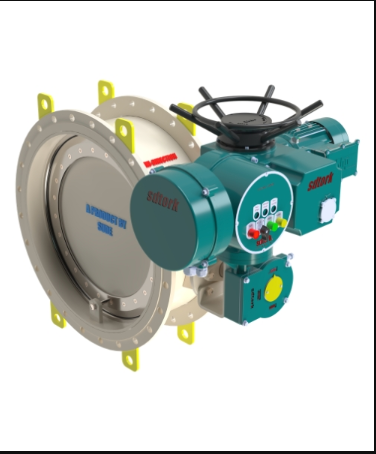
Butterfly dampers are widely used because of their relatively simple construction and compact installation requirements. A rotating blade positioned inside the flow passage can regulate or restrict the movement of air or gas. Depending on the design, the damper may be used for throttling, isolation, or both.
The performance of a butterfly damper depends on factors such as blade thickness, shaft construction, sealing arrangement, material selection, and actuator compatibility. In high-temperature applications, special materials and suitable sealing systems may be required. Industrial users should also consider whether the damper will operate continuously, periodically, or only during maintenance and emergency isolation.
Guillotine Dampers and Isolation Systems
Guillotine dampers are often associated with applications where isolation is more important than precise throttling. Their sliding blade design can provide a physical barrier within a duct or process passage. This makes them useful in systems where one section needs to be separated from another for maintenance or operational purposes.
The construction of a guillotine damper must be appropriate for the process conditions. Heavy-duty frames, suitable sealing arrangements, and durable blade materials may be required in applications involving abrasive particles or elevated temperatures. The actuator must also have sufficient force to move the blade reliably under the expected operating conditions.
Materials Used in Industrial Dampers
Material selection has a direct effect on damper service life. Carbon steel may be suitable for many general industrial applications, while stainless steel can be considered where corrosion resistance or specific process conditions demand it. Other alloys may be selected for high-temperature or chemically aggressive environments.
Material decisions should be based on the actual operating conditions rather than assumptions about the industry alone. Temperature, humidity, chemical exposure, abrasive particles, pressure, and gas composition can all affect material performance. Seals and other internal components also require careful consideration because their temperature and chemical resistance may differ from that of the main damper body.
Applications Across Different Industries
Industrial dampers are used across numerous sectors because air and gas-flow control is an important part of many manufacturing processes. Power generation facilities may use dampers in boiler, flue-gas, combustion-air, and exhaust systems. Cement plants can require equipment capable of handling dusty and abrasive process environments.
Steel plants, foundries, chemical facilities, pharmaceutical manufacturing units, food-processing plants, mining operations, and waste-treatment facilities may also use industrial dampers. Although the basic purpose remains flow control or isolation, the actual design requirements can be very different between industries. This is why application-specific engineering is an important part of industrial damper selection.
Dampers for Power Plants
Power plants often operate large air and gas-handling systems where dependable flow management is essential. Dampers can be installed in combustion-air systems, exhaust ducts, flue-gas arrangements, boiler systems, and other process sections. Depending on their position, they may regulate flow or isolate equipment during maintenance.
Temperature and pressure are important considerations in these applications. Materials, seals, bearings, and actuator systems must be selected according to actual operating conditions. Large dampers may also require reinforced structures to withstand mechanical loads and repeated operation. A correctly engineered system can support controlled operation while making maintenance and isolation procedures more practical.
Industrial Dampers for Cement and Mining
Cement and mining environments can expose equipment to significant levels of dust and abrasive material. Dampers installed in these systems therefore require appropriate construction and protection. Blade design, sealing, shaft arrangements, and bearing protection can all influence service life.
An Industrial Damper Manufacturer India serving these applications may need to consider material abrasion, high temperatures, particulate loading, and frequent cycling. A damper designed for clean-air ventilation may not be suitable for a dusty process line. Understanding the actual process conditions helps engineers select a construction that can withstand the environment and maintain acceptable performance.
Dampers in Steel Plants
Steel manufacturing involves several high-temperature and gas-handling processes. Industrial dampers may be used in furnace systems, exhaust arrangements, combustion systems, dust collection networks, and other sections where controlled movement of gases is required.
These applications can involve demanding temperature conditions and frequent operational changes. Damper construction must therefore consider thermal expansion, mechanical strength, sealing, and actuator performance. In large systems, even small design limitations can affect maintenance and operational efficiency. Proper engineering helps ensure that the damper is compatible with the surrounding equipment and process requirements.
Electric and Pneumatic Damper Actuation
Industrial dampers can be operated through different actuation methods. Electric actuators are often selected where integration with an automated control system is required. They can provide controlled positioning and can be connected to plant-level monitoring or control equipment.
Pneumatic actuators can be useful where compressed air is readily available and fast operation is required. The choice between electric and pneumatic actuation depends on factors such as operating speed, available utilities, control requirements, environmental conditions, and safety considerations. Manual operation may still be appropriate for smaller or infrequently operated dampers.
Factors to Consider Before Selecting a Damper
Choosing a damper requires more information than simply knowing the duct diameter. Engineers should evaluate the type of media, operating temperature, pressure, flow velocity, required leakage level, frequency of operation, and installation environment.
The required function should also be clearly defined. A damper intended for throttling may require a different design from one used exclusively for isolation. Similarly, an emergency shutdown application may require faster actuation and specific fail-safe characteristics. Understanding these requirements before procurement can reduce the risk of selecting equipment that does not match the process.
Importance of Custom Damper Manufacturing
Standard products can meet many common requirements, but industrial projects frequently involve unusual dimensions or demanding operating conditions. Custom manufacturing allows the damper design to be adapted to the available installation space and process requirements.
A customized damper may involve specific flange dimensions, blade configurations, materials, sealing arrangements, actuator mounting systems, or shaft designs. The objective is to create equipment that integrates properly with the surrounding system. This can be particularly valuable for replacement projects where existing equipment dimensions cannot easily be changed.
Quality and Manufacturing Considerations
Quality control is an important part of industrial damper manufacturing. Components should be produced with appropriate dimensional accuracy, structural integrity, and suitable surface and material characteristics. Welded assemblies may require inspection to identify potential manufacturing defects, while moving components need appropriate alignment.
Testing requirements depend on the type of damper and its intended application. Functional checks can verify that blades, shafts, linkages, and actuators move correctly. Where sealing performance is important, appropriate inspection or testing methods may also be required. Documentation can help maintenance teams understand the equipment and its operating requirements.
Maintenance of Industrial Dampers
Regular inspection can help identify developing problems before they result in operational failure. Maintenance teams may inspect shafts, bearings, seals, blades, linkages, actuator connections, and mounting hardware. Dust accumulation or corrosion may also need to be addressed depending on the application.
The maintenance schedule should reflect actual operating conditions. A damper exposed to high temperatures, abrasive particles, or corrosive gases may require more frequent inspection than equipment operating in a cleaner environment. Keeping records of maintenance and operating problems can also help identify recurring issues and support future replacement decisions.
Why Manufacturer Experience Matters
Industrial damper performance depends on the relationship between design, materials, manufacturing quality, and application conditions. A manufacturer with experience across different industrial environments can better understand how these factors interact. Technical discussions before ordering can help identify important requirements that may otherwise be overlooked.
An Industrial Damper Manufacturer India can also provide different configurations for industries with varying technical needs. The important consideration is not simply manufacturing capacity but the ability to understand application requirements and produce equipment that matches the intended service conditions.
Benefits of Properly Selected Industrial Dampers
A correctly selected damper can contribute to effective flow management, easier system isolation, improved process control, and more convenient maintenance. Proper sizing can help avoid unnecessary pressure losses, while appropriate materials can improve durability in demanding environments.
Reliable operation can also reduce interruptions caused by premature component failure. When dampers are integrated with suitable actuators and control systems, operators may gain better control over automated processes. These benefits depend heavily on proper engineering, installation, commissioning, and maintenance.
Future Trends in Industrial Damper Technology
Industrial systems are becoming increasingly automated, creating greater demand for equipment that can communicate with control systems. Smart actuators, position feedback, remote monitoring, and automated diagnostics are becoming more relevant to modern industrial installations.
Future damper systems may increasingly focus on energy efficiency, predictive maintenance, improved sealing, and digital monitoring. These developments can help operators understand equipment performance and identify maintenance requirements before serious failures occur. However, the basic principles of correct sizing, material selection, mechanical reliability, and suitable installation will remain important.
Conclusion
Industrial dampers play an important role in controlling and isolating air, gas, fumes, and process flows across many industrial sectors. From power plants and cement facilities to steel plants, mining operations, chemical industries, and manufacturing units, the correct damper design can support reliable system operation and maintenance.
Choosing an Industrial Damper Manufacturer India should involve careful consideration of engineering capability, material selection, customization, manufacturing quality, actuation options, and application experience. Different processes require different damper designs, and factors such as temperature, pressure, media, abrasion, corrosion, and operating frequency should be evaluated before selection. With appropriate design, manufacturing, installation, and maintenance, industrial dampers can provide dependable flow-control and isolation performance for demanding industrial environments.